
Tadpole Flange Gasket and Sealing Strip (TG)
A high-temperature bulb-and-tail sealing profile engineered for flanged expansion joints, shielding composite fabric layers from sharp clamping bar edges and bolt-head pinch shear while ensuring gas-tight sealing meeting RAL-GZ 719 (EN 1593 Nekal® foam test) and BundleTec extended helium tightness criteria (Q ≤ 10⁻³ mbar·l/(s·m)) in positive-pressure systems.
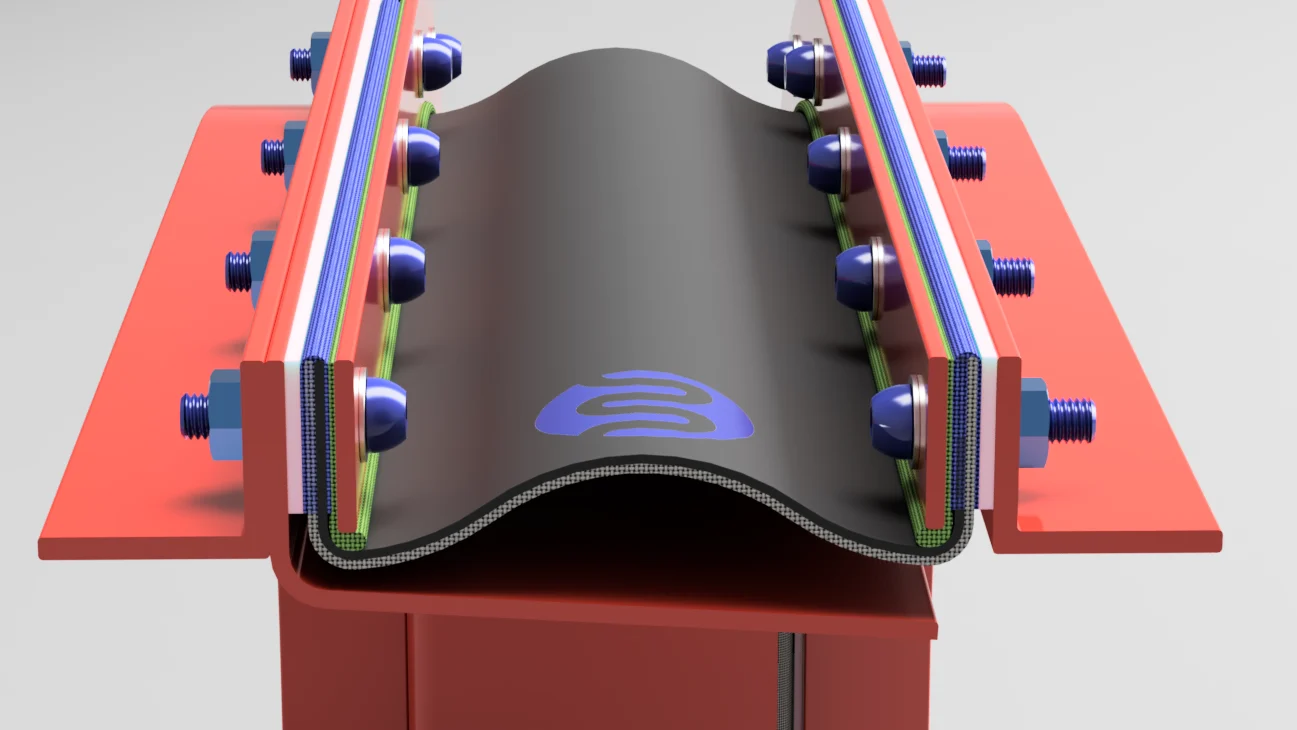
During expansion joint installation, the fabric belt is compressed between duct flanges and metal clamping bars. When clamping bolts are torqued and duct vibration begins, the sharp inner edge of the clamping bar acts like a guillotine, creating pinch notch tears in the fabric.
The BundleTec Tadpole Flange Gasket (TG) features a resilient bulb core with an extended fabric tail that tucks beneath the clamping bar. The bulb forms a protective bumper along the sharp metal edge to eliminate notch shear, sealing flange gaps across ±15,000 to ±35,000 Pa.
Thermal Duct Expansion & Sizing Engine
Interactively calculate axial and lateral thermal expansion, temperature gradients, and cold setting offsets.
Overview
The Tadpole Flange Gasket (TG) is a specialized sealing and protection profile for flanged fabric expansion joints. Designed with a circular elastic bulb and a flat mounting tail, it distributes clamping bolt forces evenly, covers sharp steel edges, and prevents localized shear failure under vibration.
Applications
- Positive-Pressure Centrifugal & Axial Fan Ductwork
- High-Vibration Ventilation and Process Gas Lines
- Flue Gas Desulfurization (FGD) Scrubber Flange Joints
- Cement Plant & Power Station Clamped Expansion Joints
- All Flanged Non-Metallic Duct Expansion Bellows
Technical Advantages
- Completely prevents clamping bar edges from guillotine-shearing (notch shear) the fabric
- Distributes bolt torque evenly to prevent localized fabric crushing around bolt holes
- Resilient bulb profile provides superior gas-tight sealing meeting RAL-GZ 719 criteria under positive pressures
- Tiered cores: silicone (≤220°C), Inconel-clad glass rope (220–550°C), and CMS-Bio + Inconel mesh (550–1000°C)
- Fully compliant with FSA Non-Metallic Handbook (Chapters 4 & 5) and RAL-GZ 719 flange assembly guidelines
TG Technical Parameters & Operational Limits
| Bulb Head Diameter | 12 mm to 35 mm (Sized to flange and bar profile) |
| Tail Width Spectrum | 30 mm to 100 mm (Sized to clamping bar width) |
| Operating Temp Range | -50°C to +600°C (Up to +1000°C with ceramic core) |
| Recommended Torque | M10: 20–25 / 25–30 Nm · M12: 35–40 / 40–50 Nm · M16: 60–70 / 70–85 Nm · M20: 95–110 / 120–140 Nm (Soft / Multi-Ply; compression limiters, A4-70 nickel anti-seize -20–25%, 3-pass cross-star, 24h hot retorque) |
| Outer Jacketing | PTFE-Coated E-Glass (≤260°C), Aramid (≤200°C cont. / +250°C peak), E-Glass (≤550°C), or High-Silica / Inconel Mesh (≤1000°C) |
| Standard Compliance | FSA Non-Metallic Handbook (Chapters 4 & 5) · RAL-GZ 719 (EN 1593 Nekal® ≥50 hPa) |
Tadpole Flange Gasket and Sealing Strip (TG) — Detailed Architectural Design
1. Clamping Shear Stresses & Contact Pressure Distribution
When expansion joint fabric is torqued between steel flanges, unradiused clamping bar edges concentrate extreme shear stresses. Under process vibration, this sharp edge acts like a blade (notch shear failure). Concurrently, positive pressure gas leaks around bolt pitches. The Tadpole gasket simultaneously resolves both mechanical and sealing challenges.
2. Core Metallurgy & Elastic Memory Recovery
The Tadpole bulb core is tailored to process severity: Solid or sponge silicone covers temperatures under 220°C, while Inconel 625-clad glass rope handles 220°C to 550°C. Above 550°C, Inconel 625 spring-assisted bio-soluble ceramic fiber is used. Jacketing is PTFE-impregnated glass fabric.
3. Fastener Selection & Fastener Head Geometry
Standard hex bolts can pinch and distort fabric corners. BundleTec mandates dome-head (button/carriage) or flanged hex stainless steel bolts paired with wide heavy flat washers. This configuration transforms tightening torque into uniform contact pressure (P_contact > 3.5 MPa) across the full perimeter.
4. Plant Case Studies & Corner Radiusing Instructions
On a cement ID fan discharge joint where belts tore every 3 months at the clamping bar edge, retrofitting BundleTec Tadpole gaskets eliminated all tears, yielding 6+ years of uninterrupted service. In rectangular ductwork, mitered corner pieces ensure the bulb transitions without buckling or bunching.
Calculate duct thermal growth and configure the right component →
Input duct cross-section and process temperatures to immediately determine axial and lateral displacement.
Compliant International Quality & Manufacturing Standards
All internal expansion joint components are engineered and fabricated to FSA and RAL-GZ 719 guidelines.
Official RAL-GZ 719 (March 2017) governs single and multi-layer designs. Baseline tests cover EN 1593 Nekal® (≥50 hPa), DIN 53508, and ISO 13934-1.
The FSA Non-Metallic Handbook (Chapters 4 & 5) sets clamping and torque rules. It specifies R ≥ 3 mm radii and 10–12% belt slack.
Zone 1/21 and 2/22 ducts use conductive PTFE (Rs < 10⁶ Ω). Equipotential bonding jumpers and T-Class surface limits ensure explosion safety.
Frequently Asked Questions
What is a Tadpole gasket and why is it named "Tadpole"? +
A Tadpole gasket is a custom bulb-and-tail profile consisting of a round resilient core (head) and an extended flat fabric strip (tail). Its resemblance to a tadpole gives it this standardized engineering name.
How does the Tadpole gasket stop clamping bar edge shear? +
The flat tail sits under the clamping bar while the round bulb head rests directly against the bar's sharp inner edge. This forms a resilient bumper that keeps steel edges from cutting the fabric.
How does it improve gas tightness in positive pressure systems? +
When clamping bolts are torqued, the resilient bulb compresses to fill micro-imperfections along the flange face, sealing leaks even under pressures up to ±35,000 Pa (±350 mbar).
How are Tadpole gaskets installed around 90-degree duct corners? +
In rectangular duct corners, pre-mitered factory corner segments or radiused transitions are used to prevent the bulb from bunching and creating localized leak paths.